

Vectoring
& Near Miss

Determining the next best drill location and identifying whether previous drilling may have narrowly missed mineralisation are critical to a successful exploration campaign.
Datarock empowers mining companies to optimise drilling strategies and enhance discovery potential by applying data-driven workflows. These approaches help explorers recognise when they’ve been close to a mineralisation target and provide directional insights to guide the next drill hole more effectively.
.

Datasets
Vectoring and near miss projects will typically utilise any relevant drill hole and geophysics datasets that can either directly or indirectly detect mineralisation or alteration signatures:
- Assays/geochemistry
- Spectral and mineralogy datasets
- Structural & geotechnical logging
- Geology logging
- Geophysics
- Core scanning datasets
- Downhole geophysics

Value
- Improved stakeholder confidence in drilling programs by using data to quantify exploration uncertainty
- Data fusion increases ore body knowledge by integrating and building quantified relationships between complex geoscience datasets
- Complementary targeting methods that can be compared and contrasted against traditional exploration models
Use cases
Vectoring analysis
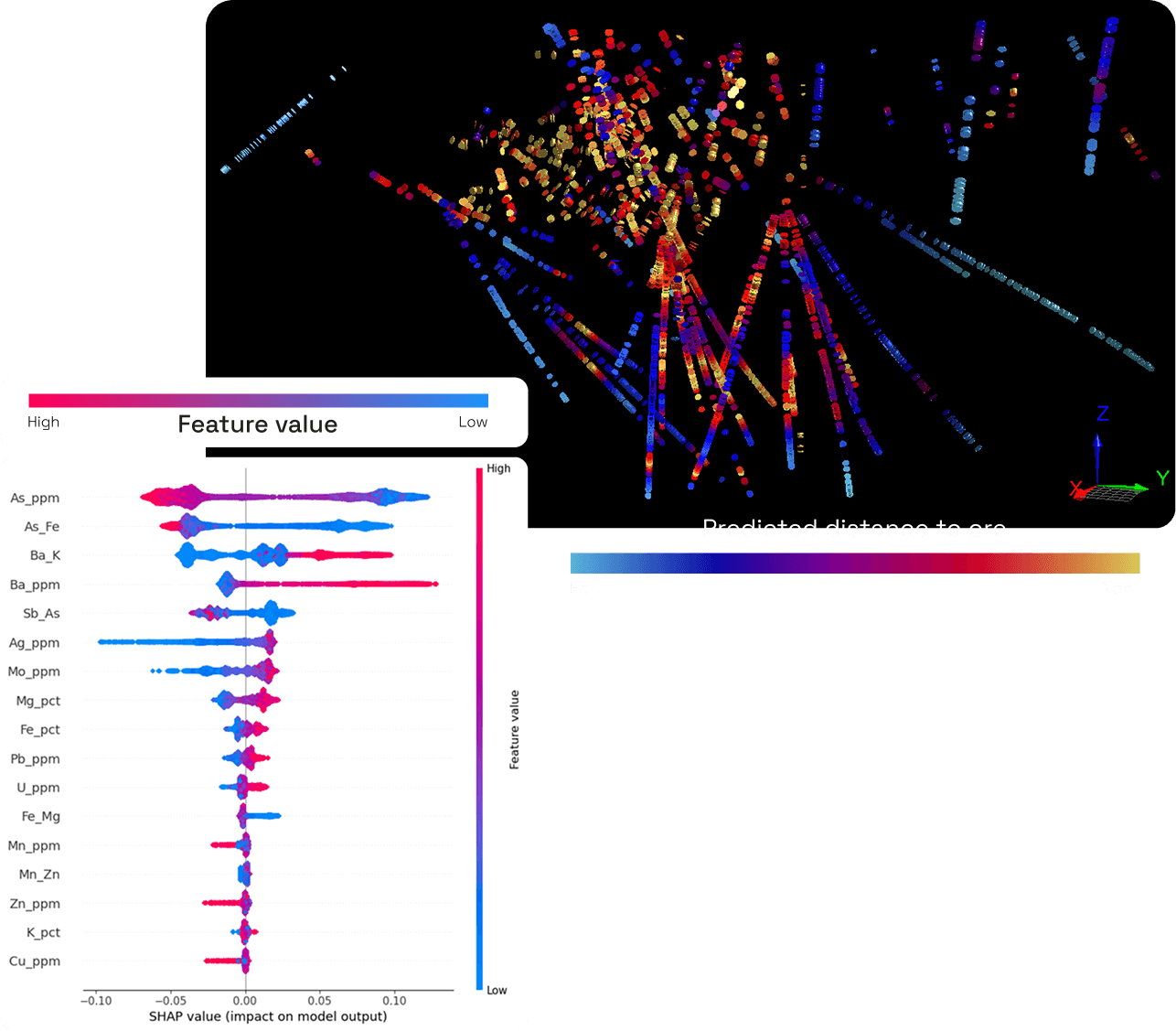
Vectoring analysis aims to determine the direction and distance to mineralisation from surrounding barren or weakly mineralised zones to target prospective mineralisation. Our approaches typically combine data analytics with geochemical gradients, alteration patterns, and structural features or other candidate datasets to guide further drilling.
Applications
- Build vectoring models to increase drill efficiency
- Apply a data-driven approach to drilling programs
- Quantify and rank drilling options to improve targeting confidence

Near miss analysis
This approach identifies drill holes or exploration activities that came close to, but did not intersect target mineralisation.
By learning from these misses, exploration teams can reassess targeting strategies, refine geological models, and reduce false negatives. It helps avoid “walking away too soon” from potentially mineralised systems due to small positional or geological interpretation errors.
Applications
- Help define the edges and geometry of mineralised systems
- Build a real-time model to flag potential near misses as new drilling data is acquired supporting in-field decision making


Similarity mapping / Library comparison
As geologists we spend a lot of time comparing new geology with rocks we have seen before. Using data analytics, Datarock can build models and libraries that allow for the rapid quantification of similarity across various types of geoscience data.
An example of this type of approach is the comparison of 4-acid geochemistry responses in exploration holes (orange) and resource holes that intersect economic mineralisation.
Applications
- Rapidly contextualise new data within the framework of existing ore body knowledge
- Build a calibrated proxy for near-miss detection
- Develop a reference library of prospective or near-miss signatures for application to future drilling


