

from Proof of Concept to trusted, reliable workflows
By Luisa D’Andrea, Principal Geoscientist, Datarock
TL;DR: Datarock’s AI-powered core logging technology is crossing mining’s adoption chasm, evolving from innovative Proof of Concept, to production-ready geological infrastructure. “Early adopters” validated automated core analysis and geotechnical parameter generation, but today’s “early majority” demands integration with existing databases, 3D geological models, and mine planning workflows. The shift reflects mining’s maturation from “can AI really predict RQD from drill core photos?” to “does this deliver auditable, scalable, consistent geotechnical data across our global portfolio?”.
As mining technology matures, the challenge isn’t proving what is possible, it’s proving what is reliable at scale, across multiple sites, and within existing workflows.
At Datarock, I spend most days chatting with people from across the mining industry, listening to their stories to better understand the challenges they face on site, and exploring how we can help. It’s one of the best parts of my job, talking to Chief Geologists and Engineers from Kiruna to Kalgoorlie. There’s a real buzz in those conversations: the problem-solving, the curiosity, the sense of where the industry is heading.
But in the past few months, something has changed. The energy is still there, but it feels different, more grounded, perhaps even more cautious or serious. When I first started at Datarock in 2020, the discussion was more about the excitement of new tech: “This is cool!” “Can you really quantify a vein from core photos?” Nowadays, over the past 6 months in particular, the questions sound more like, “How do we actually integrate with the core shed practices and 3D modelling software?”, “What difference will it make to our geos time on site?” “How do we check the data quality against manual site logging?” “Can we gain knowledge, through a consistent dataset across the orebody?” It’s a shift from enthusiasm to impact; from experimentation to integration; curiosity to pragmatism.
This is the story of how Datarock is helping the mining industry to cross “the chasm” and turning AI-powered geological innovation from a shiny new idea into trusted, everyday infrastructure.
Mining at the edge of change
Mining has always stood at the intersection of tradition and innovation. At Datarock, we’ve had a front-row seat to one of the industry’s most profound technological shifts: the rise of data-driven geology and geotech. We have seen forms of AI, such as machine learning models and computer vision, transform how geoscientists and engineers can interact with their data, from visualising textures to quantifying mineralogy to automatically generating geotechnical parameters. But the journey from early excitement to widespread adoption is rarely straightforward.
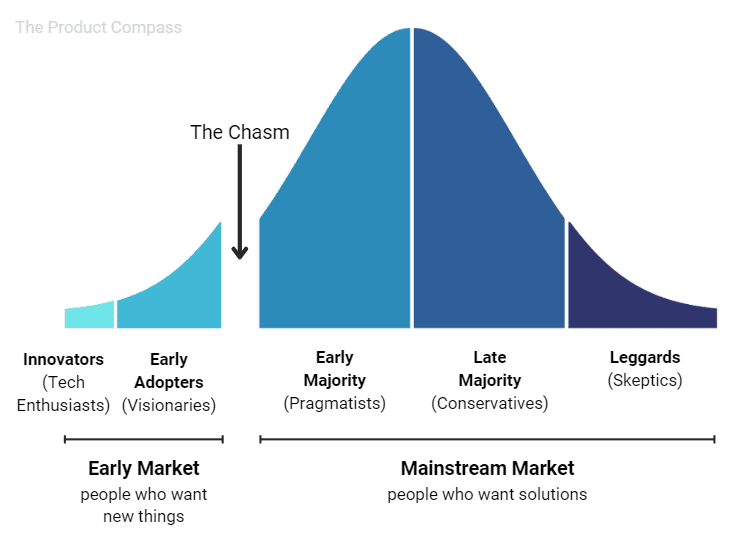
That journey is what Geoffrey Moore famously called “the chasm.”
In his seminal book ‘Crossing the Chasm’ (1991), Moore identified a critical gap in tech adoption: the leap from early adopters (who love innovation for its own sake) to early majority (who are looking for reliability and proven outputs). According to Moore, this is when promising tech fails, not because it doesn’t work but because companies can’t transform from pilot to production, into scalable and trustworthy outcomes.
The early market: technical trailblazers and visionaries
Every innovation starts with a small group of believers. The people who see what is possible before it is proven. In mining, these are the technical trailblazers: geologists, engineers, and data scientists who are both curious and courageous. They’re the ones who always want to overhaul that spreadsheet that’s been used for years; we all know one!
When Datarock first introduced its AI-driven drill core image analysis, these were the users who jumped in headfirst. They were willing to explore, experiment, and push boundaries. They wanted to understand how the models worked, not just what they produced. They would scrutinise pixel-level segmentation outputs, debate classification thresholds, and share feedback that shaped our product’s evolution. We worked with these geoscientists and engineers and guided them through their understanding (and ours!) to develop a multi-mine site solution, encouraging them to be internal champions of our solutions. From customers who stated, “I don’t even know how to spell AI!” to fully integrate core shed solutions where “no geotechnical engineers were harmed in the process!”, we’ve been on an almost 10 year journey with the industry.
These early adopters were the heartbeat of innovation, and they saw that automated logging and texture classification weren’t just futuristic ideas, but practical tools that could transform the way the geosciences were done.
For them, technology was a collaborative process, not a finished product. They were comfortable with imperfection, comfortable with the iterative process of learning, tuning, and improving.
We are forever grateful for the trailblazers who believed in the vision when it was still rough around the edges. Your curiosity and rigorous feedback helped to make the product what it is today. But curiosity and experimentation alone don’t build industry standards.
The chasm: from innovation to integration
The chasm is a proving ground. It’s the stage where new technology must mature beyond excitement and demonstrate real-world reliability.
In mining, that means moving from pilot projects and technical enthusiasm to integrated, scalable solutions that operate within complex systems such as production databases, 3D modelling platforms, mine planning workflows, and corporate data governance structures.
The questions evolve.
It’s no longer,
- “Can this model detect spodumene in core photos?”
- “Can RQD be predicted in my underground drill program from core photos?”
It becomes,
- “Can this technology consistently integrate with my existing geological model, automatically push data to our database, and deliver value across multiple sites?”
- “Can this technology consistently produce geotechnical parameters as a back up to manual logging, or create datasets not even logged on site?”
Crossing the chasm means delivering confidence at scale. It’s about transforming AI from a clever, cool tool used by a few specialists into dependable software that “just works” across operations by users of all technical abilities.
And this transformation requires something that’s often underappreciated in tech: endless patience, industry guidance and partnership.
The early majority: thoughtful, serious, and engaged
The next wave of adoption in mining doesn’t come from sceptics, it comes from pragmatists. These are the professionals who are deeply engaged, but deliberate, measured, perhaps even cautious or natural sceptics! They understand the potential of technology, while also understanding the weight of operational responsibility. These are the customers who look beyond a Proof of Concept project; who look to roll out geotech solutions across multiple mine sites around the world; who understand the need for co-ordinated interoperability with databases and 3D modelling software; who would like to standardise geotechnical Modifying Factors, and so do a deep dive into comparisons between manual and automated logging.
They’re not chasing novelty; they’re pursuing dependable progress.
They ask the right questions:
- “How accurate are the models across varied lithologies or veins?” – Can I better understand the orebody model and quantify features previously unlogged on site?
- “How much confidence can I place in the geotechnical products?” – Can I use the outputs in mine design models?
- “How does the system handle data security and governance?” – How can I use the data in a stock exchange release?
- “What’s the traceability of each prediction?” – Can I run a model today, tomorrow, next week, next year, and it return a consistent prediction?
- “Can this solution scale across our portfolio without disrupting existing workflows?” – Can I standardise a company approach, and free up time in the core shed?
Far from resisting innovation, these users are ensuring it endures, ensuring it is worth the effort of making the change. They adopt technology not because it is new, but because it is ready.
For Datarock, serving this audience means more than delivering precision. It means delivering trust. That trust is earned through transparency, repeatability, and a commitment to evidence. Our models must be explainable, our workflows auditable, and our outcomes defensible.
When technology meets these expectations, it moves from being an experiment to being infrastructure.
Building the bridge
Crossing the chasm is about grounding innovation into the everyday rhythm of work.
At Datarock, that means transforming AI-powered geological and geotechnical analysis into tools that seamlessly support the workflows geologists already know and trust. It’s meant building interfaces that are intuitive for non-technical users while maintaining the depth needed by data scientists. It’s meant to ensure that our outputs don’t just live in isolation, but flow directly into downstream 3D software, and mine planning software.
The bridge is built through collaboration, not only between technology and geology, but between people. Between geotechnical engineers and geologists. Between exploration departments, and mining operations. Between customers and service providers. Every deployment teaches us something new. Every integration strengthens reliability. Every conversation with a thoughtful, serious user, makes the product stronger.
This is how innovation matures, not by leaping the chasm in one bound, but by building the bridge one trusted step at a time.
From curiosity to confidence
As mining continues its digital transformation, the focus is shifting from what is possible to what is proven. The early innovators have shown the way (thank you!); the early majority are now defining the standards (let’s go!).
At Datarock, we are genuinely proud to be part of that evolution, helping the industry move from curiosity to confidence.
Because in mining, technology doesn’t win when it’s new.
It wins when it’s trusted, and used.


